

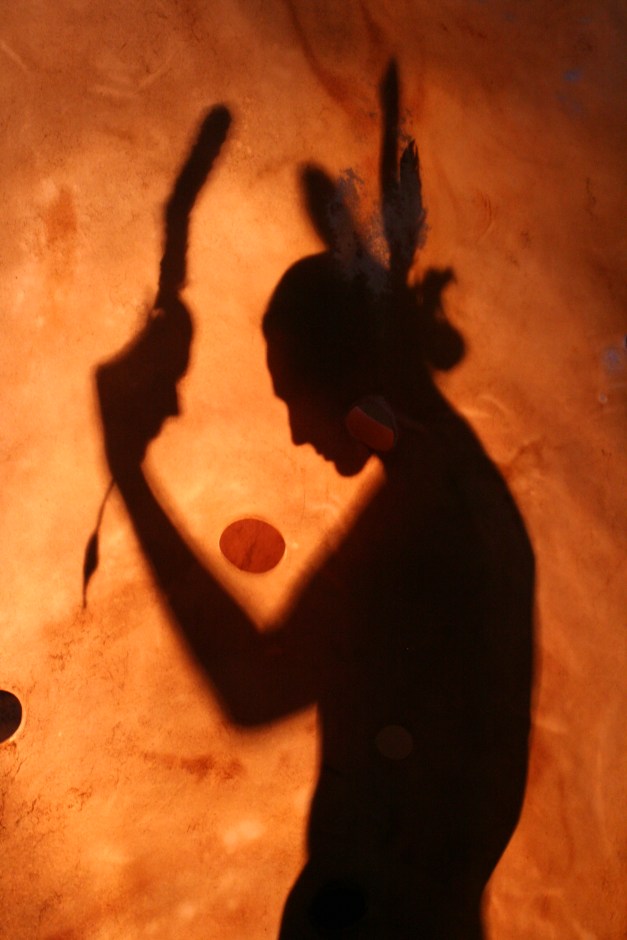
I have a show coming up at the Alaska Native Arts Foundation in Anchorage 500 West 6th Avenue. It opens February 1st 5pm- 8pm and is up all month. There will be halibut skin masks, salmon skin vessels, salmon skin masks, and moose hide silhouettes. I will be up the month of February.
The show opens Friday January 4th 6-8pm. I will have ten to fifteen pieces at a show in January at the Kenai Visitors Center during the month of January.

I currently have a show up at the Pomegranate Cafe on 2nd ave downtown Fairbanks. It will be up all September. The show is mostly salmon skins, with a couple of halibut skins, and a moose heart bag.

I currently have a show up at the Fairbanks Community Museum on 5th and Cushman in the old City Hall Building. Stop by and check out the work. 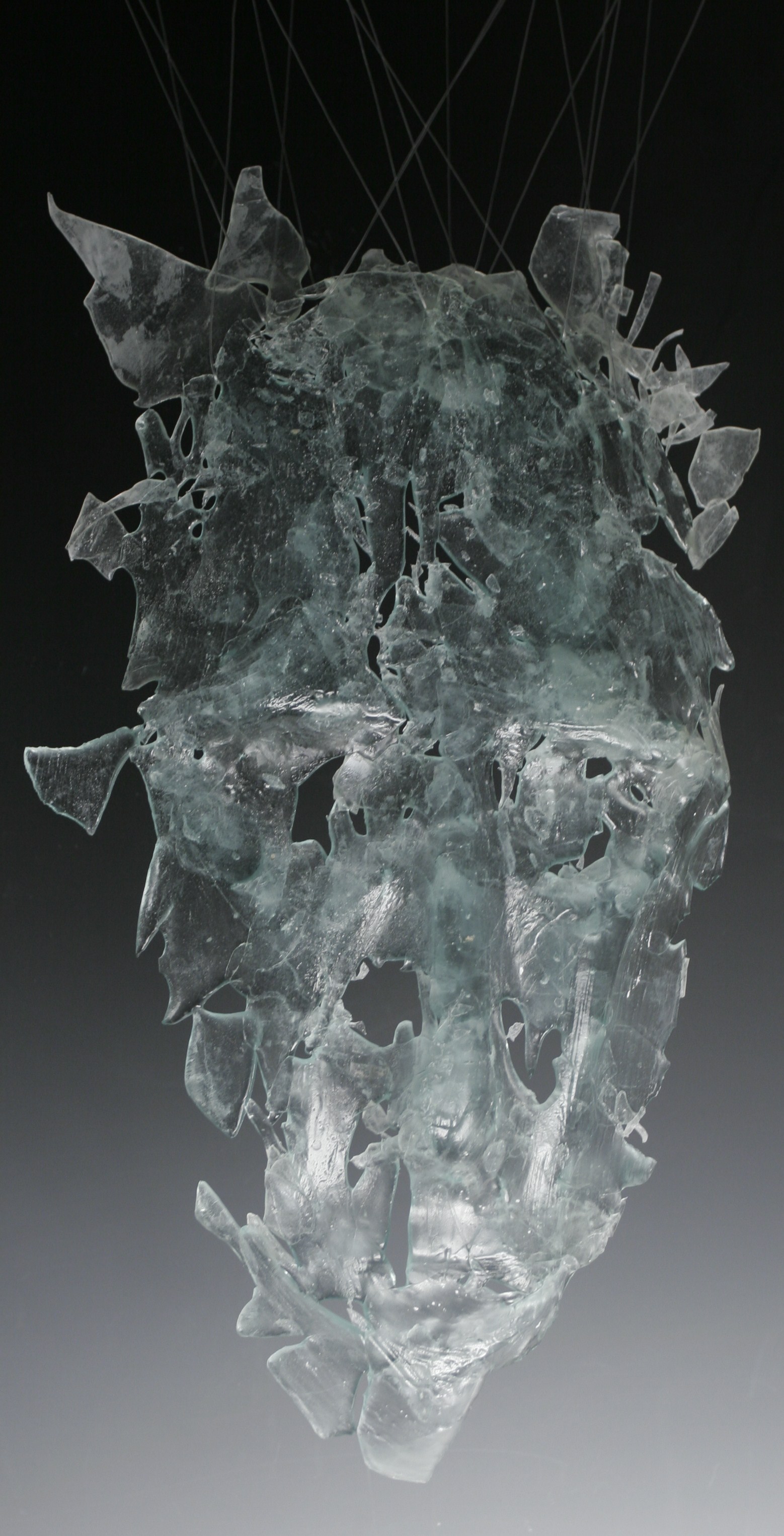

David Siqueiros
Paisaje Montanas
1968
Lithograph
21 1/8’’x 15 ½ ‘’
I chose this artist because I like his style. I also chose him because I think he was very successful in evoking emotion. I don’t in particularly like his color palate or the content in many of his works, but I do like the Paisaja Montanas. I think it is a very interesting in terms of line, color, and movement. For me the image evokes dark feelings but still looks alive. It reminds me of Magdalena Abakanowicz plaster, steel, and wooden figurative sculptures in terms of emotional response. I really like the power of the tone of red he used. I think that he successfully incorporated the green commentary color with it as well. The piece does feel a little flat even though there is so much motion in it. It would be interesting to see the piece with the focal point a little more removed from dead center.
I chose to not look at his bio before I looked at his work. After looking his larger body of work I got the feeling that he felt very oppressed and trapped in a violent way. After reading his bio it made complete sense to me since he was jailed and was part of the Mexican Revolution.
http://www.adanigallery.com/Siqueiros/main.html
This is the bio from the Adani gallery website.
| “David Alfaro Siqueiros (1896-1974) together with Diego Rivera and Jose Clemente Orozco are considered to be the three masters of the Mexican school of mural painting. Siqueiros, born in Chihuahua, México, was a sergeant in the Mexican Revolution and a colonel in the Spanish Civil War. He was very active in the organizing of México’s labor forces, and his political activism resulted in many deportations and years in jail. It was in jail where he created most of his easel works. He incorporated many new materials and techniques, and was the first artist to use acrylics as a painting media. |
| The distinctive “Siqueiros three-dimensional” perspective is unmistakable. Jackson Pollack was one of his many apprentices.” |

Embrace, El Anatsui, 2009
I find El Anatsui’s use of material to be amazing. It is well executed and clean looking. He has completely transformed a material from garbage to an art object. I also respond strongly to the scale. If they were smaller I don’t think they would have the same effect at all. I love that he has taken a traditional art form, like weaving, and reinterpreted it into a new material and method. I also well to his use of color. I like that he is limited to what he finds. His work speaks for itself, and I feel that he has taken the time to find his cultural roots enough so that his work is honest and genuine.
El Anatsui (born 1944) is a Ghanaian sculptor active for much of his career in Nigeria.
Anatsui was born in Anyako, and trained at the College of Art, University of Science and Technology, in Kumasi, in central Ghana. He began teaching at the University of Nigeria, Nsukka, in 1975, and has become affiliated with the Nsukka group.[1]
Anatsui’s preferred media are clay and wood, which he uses to create objects based on traditional Ghanaian beliefs and other subjects. He has cut wood with chainsaws and blackened it with acetylene torches; more recently, he has turned to installation art. Some of his works resemble woven cloths such as kente cloth. Anatsui also incorporates uli and nsibidi into his works alongside Ghanaian motifs.[1]
El Anatsui has exhibited his work around the world, including at the Metropolitan Museum of Art, New York (2008–09);[2] National Museum of African Art, Washington, D.C. (2008);[3] Venice Biennale (2007); Hayward Gallery (2005);[4] Liverpool Biennial (2002); the National Museum of African Art (2001); the Centre de Cultura Contemporània de Barcelona (2001);< the 8th Osaka Sculpture Triennale (1995); and the Venice Biennale (1990).
http://en.wikipedia.org/wiki/El_Anatsui
http://en.cafa.com.cn/wp-content/uploads/2011/08/Embrace-by-El-Anatsui.jpg


Union Jack Boy Soldier , Tristan Schoony Schoonraad, 2010, Britain
Barriera, Matteo Pugliese, 2009, Italy
Ad Astra, Matteo Pugliese, 2009, Italy
The Renunciation, Matteo Pugliese, 2000, Italy
Tension, Matteo Pugliese, 2003, Italy
Boy Soldier Red Grenade, Tristan Schoony Schoonraad 2010, Britain
I chose the male human figure emerging and going into the wall. I chose Schoonraad’s, Boy Soldier, pieces to set a precedence for more political statement to charge Pugliese’s figures. The Boy Soldier’s are haunting and have an almost death quality to them due to their pale color and the way the face is sculpted. The eyes are closed the piece is very static. It is also self framed by the boarder of the piece almost like a coffin.
In contrast Pugliese’s Bronze pieces have life and an elegant movement and fluidity to them. They are have a carved stone quality to them and are in dramatic poses of partial human form. They have a sense of tension and agony to them. It is like they are trying to pull away from what is happening.
This is why I choose three of the figures faceing the wall and one, Barriere, escaping almost. The viewer cannot quite tell if the figure is being pushed back into the wall or if it is getting out of the wall.
I choose the pieces for contrasting materials, styles, and age. When conflict happens, be it domestic home issues or as wide spread and violent as war, children often times go through it in silence. They are completely powerless to escape what is happing to them and the scars stay with them even as they grow older.
I love the use of color, material, and form the two artists use. I think the red grenade is wonderful use of color. Red is a power color and is also loaded with symbolism of blood, love, and hate. Because the form of the child is so simple the red is able to pop. In contrast I enjoyed the way that the bronze was patina in different colors and states. The metal comes across in various stages of warm and cool tones. The works of both artist juxtapose nicely and derive raw emotions in me.
http://www.kwaifunghin.com/artists/Sculptors/MatteoPugliese/biography_eng/
Born in Milan, Italy, in 1969, Matteo Pugliese graduated from Milan University majoring in Modern Literature. During his time at university, he made sculptures and models of film and comic strip characters for his own pleasure. He now lives in Milan. Major Exhibitions include: “Freedom,” Siena (2004); “Die Ontnapping,” The Netherlands (2005); “Sculpture,” Milan (2006); “Extra Moenia,” Cagliari (2007).
http://trendhype.com/union-jack-boy-soldier-by-tristan-schoony-schoonraad/#.T3vTKmGPUrU
British Lifecast Artist Tristan Schoonraad has probably one of the most interesting backstories to an artist that we have ever had the pleasure of listening to. Working in Hollywood in the Special Effects & Make-Up departments from a young age has allowed this man the rare opportunity to work behind the scenes in many incredible movies, such as Rambo, Troy, Harry Potter, Saving Private Ryan & Gladiator. His deep knowledge of casting and moulding near perfect creations of humans, monsters & even aliens gives him the perfect springboard with which to launch his newfound career as a Fine Artist. UKAdapta predict that Schoonraad will be a key player in the art world in the next decade and remember; you heard it here first.
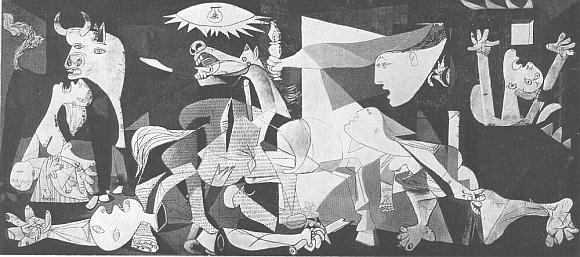
Pablo Picasso, Guernica, Paris 1937
Guernica is a large mural painting produced by Pablo Picasso for the World’s Fair Spanish Pavilion in 1937. It is 11 feet tall and 25.6 feet long painted in tones of black, white, grey, and pains grey. He produced the painting in about three months. It was a reaction the bombing of the village of Guernica in the Basque region in Spain. The town was completely leveled by German bombers. This type of warfare was only made possible with the technological advances in science. The production of larger capacity aircraft allowed for more and larger bombs to be carried in a single plane load.
World War II is largely a continuation of WWI and the settlement that resulted. War technologies that had emerged in WW I were refined in WW II. Guernica speaks to some of the effects of technology. There is a bare light bulb in the center of the piece that offers a sense of sterile clean light and speaks to the industrialization that had and was taking place during this time period. Juxtaposed to the light bulb is an oil lamp held by a wailing woman. There is a broken sword under the galloping horse, an image of a once strong weapon being shattered by a new power.
The Basque region in Spain is the mythological and traditional birthplace of the Spain, so bombing it really was an attack by the modern new world on the older culture. Guernica captures the dangers posed by rapidly advancing technology when used in the wrong way.
I personally love the painting and find it deeply moving. It was the first masterwork of art that I exposed too beyond the Mona Lisa. I learned about the painting when I was about 9 years old and saw the PBS special on it. I love that it is in black and white and the size of it is amazing. I also think that the time by painting it so fast he captured what was happening in Europe with the war. The images are haunting and graphic, but intentional all at the same time. I could relate to the piece very much. As I have become older I have learned to love it even more. I do think that it is a powerful anti war piece.
I liked the way Picasso styled the piece so much that in my painting class last year I did an Alaska version of the Guernica. After that project I grew to appreciate Guernica even more. I have included the piece for comparison.
http://www.pbs.org/treasuresoftheworld/guernica/gmain.html
http://en.wikipedia.org/wiki/Guernica_(painting)
http://www.pablopicasso.org/guernica.jsp


Liberty Leading the People, Eugene Delacroix, 1830, Paris
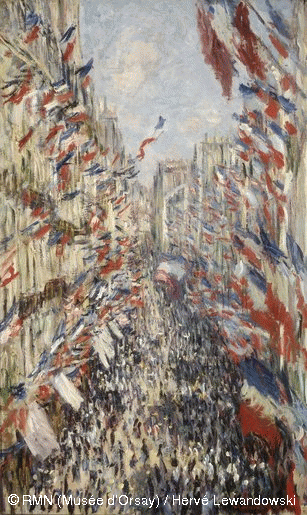
Rue Montorgueil, Claude Monet’s, 1878, Paris
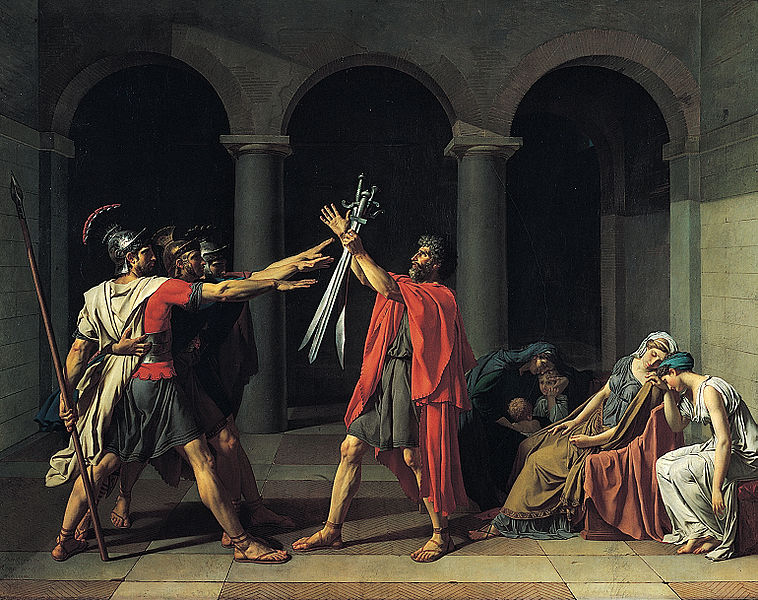
Oath of the Horatii, Jacques-Louis David, 1784, Paris
I like Impressionism as a style and I love Postimpressionism with a passion. I think very three dimensionally and when I am personally painting I approach the canvas in a sculptural manner and I personally use a combination of Impressionism and Realism. I think the two are not so far removed in the emotions they evoke but simply go about evoking the emotions in different ways. For example, Claude Monet’s painting, Rue Montorgueil, has a strong patriotic feeling with movement and energy. In Delecroix’s Liberty Leading the People, the style of realism is used to evoke a similar sense of movement and especially patriotism. Also the two paintings establish a feeling of organized chaos with the way the crowds are depicted in both paintings.
I find both works very engaging, but fascinates me is that both piece inspire me to go out and make change for the better, politically, even though I am not French. I think that Monet’s piece does a better job of transcending time because it is not as specific as Delecroix. Monet’s is not telling the viewer exactly what is happening, rather he allows the viewer to bring their own experiences to the table and react to the work.
The Oath of the Horatii, by Jacques-Louis David, is another political painting in different time period and style, Neo-Classical, which evokes similar emotions through a realistic depiction of an event. When I see the work it makes me want to be brave, bold, and stand up to protect an iconic idea. In contrast Monet’s, Rue Montorgueil, makes me want to protect ideals that a raw and in the moment for what I am going through, rather than a specific fight with physical weapons. For me this is the amazing power of Impressions and especially Postimpressionism. This style contacts each person and is more prone to generating strong feelings from several areas of emotion at the same time.
http://en.wikipedia.org/wiki/Oath_of_the_Horatii
http://www.musee-orsay.fr/index.php?id=851&L=1&tx_commentaire_pi1[showUid]=7081&no_cache=1
http://smarthistory.khanacademy.org/romanticism-in-france.html
 joelisaak
